
Why does the substructure need to be levelled?
When installing photovoltaic systems, the mounting rails must be in line so that the modules sit evenly and free of stress. However, rafters, battens, roof surfaces and substrates are rarely perfectly flat. Even a few millimetres of offset lead to stressed modules, uneven gaps and untidy rows.
The solution: the height differences are levelled out at the support points with packing shims or adjusting blocks before the substructure is finally fixed. Plastic has a clear advantage over timber here: it does not absorb moisture, does not rot and remains dimensionally stable over time, even with changing temperatures.
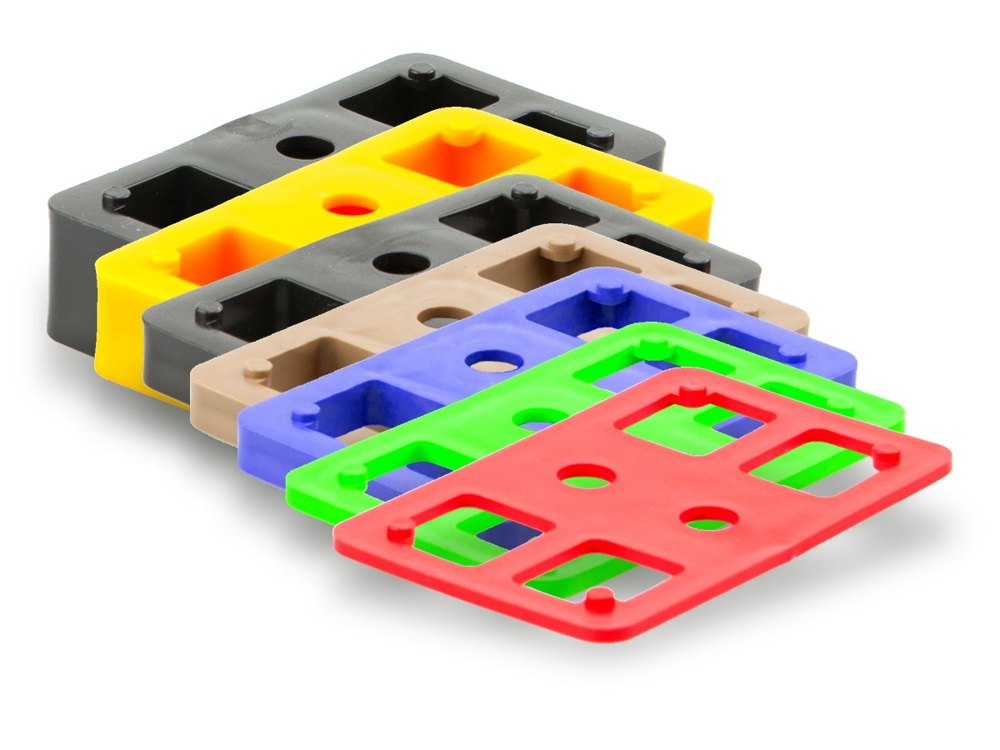
Adjusting blocks 80 × 50 mm: made for levelling
GV adjusting blocks have studs that interlock when stacked. This stops the blocks from slipping while the substructure is being aligned. Under pressure the studs disappear and the blocks bear over their full surface. The colour indicates the thickness:
| Thickness | Colour | Contents |
|---|---|---|
| 2 mm | red | 500 / carton |
| 3 mm | green | 500 / carton |
| 5 mm | blue | 500 / carton |
| 7 mm | brown | 500 / carton |
| 10 mm | black | 500 / carton |
| 15 mm | yellow | 250 / carton |
| 20 mm | black | 250 / carton |
The adjusting blocks are also available sorted in bags (MINI 40, MID 80 and MIX 155), ideal for the installation van.
Which packing shim for which support?
- Point supports: Adjusting blocks 80 × 50 mm or packing shims 70 × 70 mm. The 70 × 70 mm shims have a hole in the centre and can be screwed in place.
- Longer supports, rails and joists: Packing shims 120 × 50, 160 × 50 or 180 × 60 mm.
- Variable lengths: Breakable packing shims (variable length) 300 × 80 mm, can be snapped to the required length.
For an overview of all formats and colours, see the guide Packing shims: colours, thicknesses and formats.
How to proceed
- Take the heights: Stretch a string line or use the laser to set the target height of the rails and measure the gap at each support point.
- Rough levelling: Start by packing with the thick sizes, then use thin blocks (2 or 3 mm) to reach the final dimension.
- Stack flush: Place the blocks exactly on top of one another so that the load is transferred vertically. A few thick layers are more stable than many thin ones.
- Fix and check: Fix the substructure as specified by the system manufacturer and check the alignment of the rails once more.
Material with sunflower
Many GV products are made from a fibre composite reinforced with fibres from sunflower seed husks. It replaces up to 35 % of the petroleum-based plastic. That suits systems built for clean energy. Find out more on the Sustainability page.
Frequently asked questions
Can timber be used to pack the PV substructure?
Timber can absorb moisture, swell and rot over time. Plastic packing shims and adjusting blocks, on the other hand, remain dimensionally stable and are therefore better suited to outdoor supports.
How high can adjusting blocks be stacked?
That depends on the load and the substrate. As a rule: use a few thick blocks rather than many thin ones, and stack them flush. The specifications of the mounting system manufacturer and the structural design are decisive.
Which thicknesses are available for the adjusting blocks?
Seven thicknesses from 2 to 20 mm: 2, 3, 5, 7, 10, 15 and 20 mm, each colour-coded.
Are there compression tests?
Yes. The test reports are available as PDFs on the packing shims product page.
These notes are general guidance from practice. The applicable regulations, the specifications of the window or system manufacturers and the project-specific planning are authoritative.