
Why windows are blocked
A window must transfer its own weight as well as wind and imposed loads safely into the building structure. According to the RAL installation guideline (Leitfaden zur Montage), all forces in the plane of the window are transferred via setting blocks. Dowels, screws or installation anchors are not intended for this: they hold the window in position but do not carry its weight. Without setting blocks, subsequent damage such as jamming sashes, cracks or leaking joints is likely.
Setting block and location block: the difference
- Setting blocks sit at the bottom between the outer frame and the building structure and permanently transfer the weight of the window, typically under the frame corners and under mullions.
- Location blocks sit at the sides and top. They keep the frame at a distance and prevent it from distorting during fixing, typically near the fixing points.
What matters with the blocks
- Compression-resistant and dimensionally stable: The block must carry the load permanently without yielding. Brick fragments, timber offcuts or large wooden wedges are unsuitable.
- Space for insulation and sealing: The blocks must not obstruct the perimeter joint, so that insulation and sealing tapes can be applied continuously.
- Moisture-resistant: Plastic blocks do not absorb water and do not rot.
- Correct thickness: The joint width is set via the block thickness. Combine several thicknesses if required.
How to proceed
- Place the window in the opening and align it temporarily with mounting wedges.
- Place setting blocks of the appropriate thickness under the load transfer points, i.e. under the frame corners and under mullions.
- Insert location blocks at the sides and top near the fixing points.
- Check that the frame is plumb and aligned, then fix it.
- Remove mounting wedges that were only used for alignment if they obstruct the sealing. The load now rests on the setting blocks.
- Insulate and seal the joint.
Suitable GV blocks
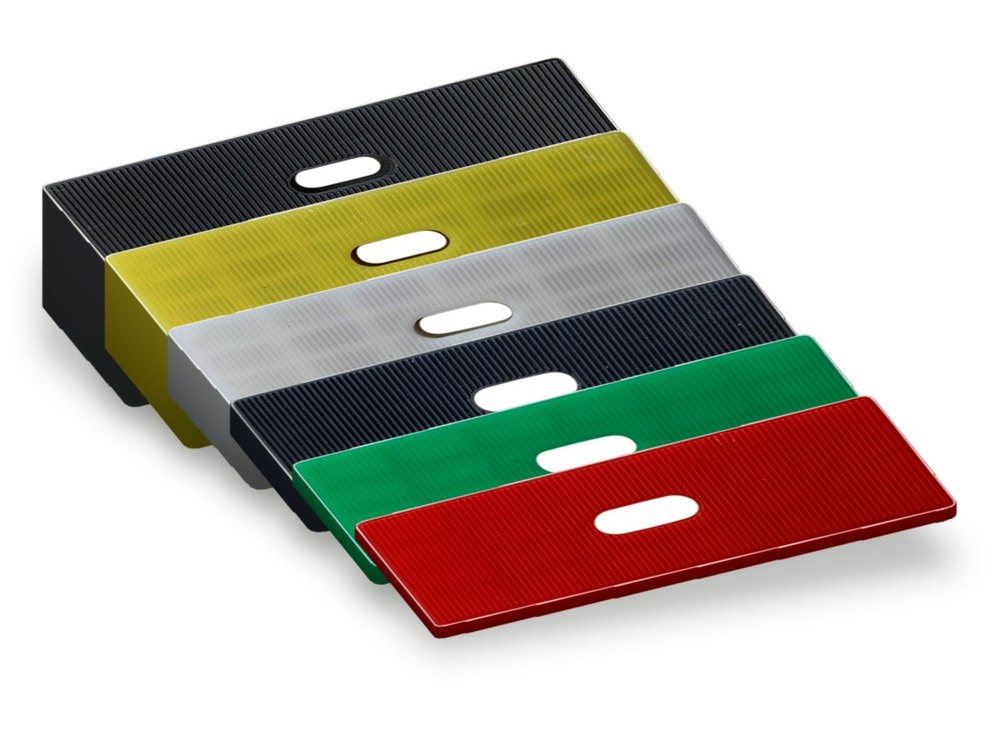
The GV load-bearing mounting blocks 80 × 30 mm are available in six thicknesses, colour-coded:
| Thickness | Colour |
|---|---|
| 2 mm | red |
| 3 mm | green |
| 5 mm | black |
| 10 mm | white |
| 15 mm | yellow |
| 20 mm | black |
For fine adjustment, packing shims from 1.5 mm are also suitable. Compression tests are available for the blocks; you can find the test reports on the product page.
Frequently asked questions
Where are setting blocks placed in a window?
At the bottom between the outer frame and the building structure, typically under the frame corners and under mullions. The window manufacturer’s specifications are authoritative.
Are frame anchors sufficient without setting blocks?
No. Fixings hold the window in position but are not designed to permanently transfer the weight in the plane of the window. According to the RAL installation guideline (Leitfaden zur Montage), setting blocks are intended for this.
What is the difference between a setting block and a location block?
Setting blocks transfer the weight of the window and sit at the bottom. Location blocks sit at the sides and top and keep the frame at a distance so that it does not distort during fixing.
Which thicknesses are available for GV load-bearing mounting blocks?
2, 3, 5, 10, 15 and 20 mm in the 80 × 30 mm format, each colour-coded.
These notes are general guidance from practice. The applicable regulations, the specifications of the window or system manufacturers and the project-specific planning are authoritative.